


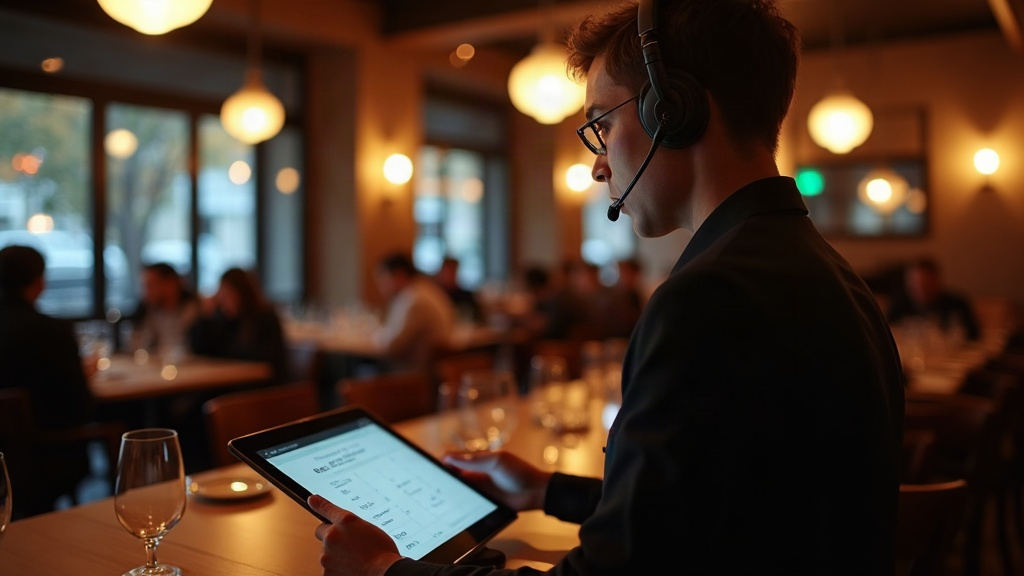
So what is an answering service, exactly? It’s a live or virtual call-handling solution that answers incoming phone calls on behalf of a business when staff can’t pick up — taking reservations, answering questions, and relaying messages in real time. For a busy New York City restaurant, that means no more missed bookings when the host stand is swamped and the phone won’t stop ringing during the 7 p.m. rush.
If you run a restaurant anywhere from the Lower East Side to the Upper West Side, you already know the problem this solves. Friday and Saturday nights bring a flood of calls right when your staff is least able to answer them. Every unanswered call is a potential no-show prevented, a party lost to a competitor, or a regular customer left frustrated.
What Is an Answering Service, in Restaurant Terms?
An answering service is a team (or a smart automated system) that picks up your restaurant’s phone when your hosts, servers, or managers are too busy to do it themselves. Calls get routed to trained agents or an AI-driven system that can take reservations, answer hours and menu questions, and pass along urgent messages.
For restaurants specifically, this usually covers:
- Taking and confirming reservations directly into your booking system
- Answering common questions — hours, parking, private dining, dietary accommodations
- Handling overflow calls during dinner rush without disrupting the floor team
- Capturing after-hours calls so you don’t lose next-week’s bookings overnight
- Forwarding urgent calls (large party changes, catering inquiries) to a manager immediately
Some services are purely human-staffed call centers. Others blend live agents with AI-assisted scripting that can handle simple reservation requests instantly, then hand off anything complex to a person. Robert Gerov Media’s answering service is built around exactly this kind of flexible setup, tailored to how a specific business actually operates.
Why Peak Hours Break the Traditional Phone System
NYC restaurants face a unique bottleneck: limited staff, high call volume, and a dining room that demands full attention the moment doors open. During peak hours — typically 6 to 9 p.m. on weekdays and nearly all evening on weekends — the phone becomes a distraction your team can’t afford.
Consider what’s actually happening at a host stand during rush:
- Walk-ins are being seated and quoted wait times
- The phone is ringing with reservation requests
- A to-go order needs to be confirmed
- A guest is asking about a dietary substitution
Something has to give, and it’s usually the phone. Industry data on missed restaurant calls consistently shows a large share of inbound calls during peak windows go unanswered — and many of those callers simply book elsewhere instead of calling back.
What Are 2 Advantages of an Answering Service for Restaurants?
Among the many benefits, two stand out as the most immediately valuable for a restaurant managing reservation overflow:
1. No Reservation Gets Lost to a Busy Signal or Voicemail
Every call answered is a chance to lock in a booking instead of losing it to silence. An answering service picks up consistently, even when five lines could realistically be ringing at once during a Saturday rush. That reliability directly protects revenue that would otherwise walk — or rather, call — away.
2. Your Front-of-House Staff Stays Focused on the Guests in the Room
When hosts and managers aren’t juggling the phone and the floor simultaneously, service quality improves for the guests who are physically there. Fewer interruptions mean faster seating, better pacing, and a calmer dining room atmosphere — which guests notice, even if they can’t quite explain why.
How Much Does Answering Service Cost?
Pricing varies based on call volume, hours of coverage, and whether the service is purely live-agent, AI-assisted, or a hybrid. Most providers structure cost around one of these models:
| Pricing Model | How It Works |
|---|---|
| Per-minute billing | You pay for actual time agents spend on calls — efficient for restaurants with variable call volume across the week |
| Monthly flat-rate plans | A set fee covers a bundle of minutes or calls, with overage rates beyond that — predictable for restaurants with consistent peak-hour patterns |
Factors that typically move the price up or down include whether you need 24/7 coverage or just peak-hour overflow support, how much reservation-system integration is required, and whether calls need multilingual handling — a real consideration in a city as diverse as New York. The smartest approach is to start with coverage for your actual rush windows rather than paying for round-the-clock service you don’t need yet.
Answering Service vs. Voicemail vs. Hiring Another Host
Restaurant owners often default to one of three options when the phone becomes unmanageable. Here’s how they actually compare:
- Voicemail: Costs nothing extra but converts almost no callers — most people hang up rather than leave a message for a restaurant reservation.
- Hiring another host: Solves the problem during scheduled shifts, but adds payroll, training, and scheduling overhead, and still leaves gaps during off-hours or unexpected rushes.
- Answering service: Scales with call volume, covers hours you’re not staffed for, and typically costs less than a part-time hire while catching calls your current team physically can’t.
For a lot of independent and multi-location restaurants, the answering service ends up being the more cost-effective middle ground between losing calls entirely and adding permanent headcount.
What Is Answering Service Integration Like With Restaurant Reservation Systems?
A good answering service doesn’t operate in isolation — it should plug directly into whatever reservation platform you’re already using. That means agents or automated systems can see real-time table availability, confirm bookings instantly, and avoid the double-booking headaches that come from a disconnected phone line.
This kind of integration matters more in NYC than almost anywhere else. With dining rooms often smaller and turnover tighter than in other markets, an inaccurate reservation count can mean overbooking a Friday night or leaving tables empty that should have been filled. Tight integration keeps the answering service working as an extension of your host stand, not a separate system you have to reconcile later.
How to Start an Answering Service Business (And Why That Matters for Restaurant Owners Too)
It might seem like an odd detour, but understanding how to start an answering service business actually helps restaurant owners evaluate the providers they’re considering. Answering service companies are generally built around:
- Trained call agents or scripted AI systems that follow a business’s specific protocols
- Call routing and forwarding technology integrated with phone carriers
- CRM or reservation-system integrations to log and confirm bookings
- Reporting dashboards so the client business can track call volume and outcomes
Knowing this helps you ask better questions when choosing a provider: Is the service truly set up to follow your restaurant’s exact reservation policies, or is it just a generic script? Can you see call logs and volume reports to confirm it’s actually working during your peak hours? Those operational details separate a service that genuinely reduces lost bookings from one that just adds another layer of hold music.
Getting the Most Out of an Answering Service During Rush Hours
An answering service works best when it’s set up with your restaurant’s specific peak patterns in mind, not as a generic one-size-fits-all script. A few things worth clarifying before you commit to a provider:
- Can coverage flex around your known busy nights (Friday, Saturday, holidays) without a long-term commitment to 24/7 service?
- Does the provider train agents on your actual menu, policies, and reservation rules, or use a generic restaurant template?
- Is there a clear escalation path for complex requests like large parties, buyouts, or catering inquiries?
- How quickly are reservations logged into your existing system so your host stand sees them in real time?
Getting these details right is what turns an answering service from a simple call-catcher into a genuine extension of your front-of-house team. It’s also worth pairing strong phone coverage with solid online visibility — after all, a reservation only comes in by phone if a diner found your restaurant in the first place. That’s where a strategy like Google My Business SEO plays a complementary role, helping more of the right diners discover your restaurant before they even pick up the phone to call.
Reservation overflow during peak hours is one of the most fixable problems a restaurant faces, and it’s one that compounds quietly — a handful of missed calls a night adds up to real lost revenue over a month. If you’re weighing whether an answering service makes sense for your dining room, Robert Gerov Media is happy to walk through how it could fit your specific hours and call patterns, and you can always find more details and reviews on our Google Business Profile when you’re ready to take a closer look.
Tells Google to show you more from Robert Gerov Media in Search.
Related Posts
Does Google My Business help SEO? Learn how NYC businesses can use Google Business Profile attributes to rank higher and win local pack visibility.
Does Google My Business Help SEO? How NYC Businesses Can Use Attributes to Stand Out
What is AI SEO and how do NYC businesses win AI answer boxes? Learn how to structure FAQ schema correctly to get quoted by AI search tools.
What Is AI SEO? How NYC Businesses Should Structure FAQ Schema
What is enterprise SEO and how does it apply to large NYC location networks? Learn how teams build internal linking architecture across hundreds of pages.
What Is Enterprise SEO? Internal Linking for NYC Location Pages
What is national SEO and why do regional markets lag despite strong NYC rankings? Learn the 7-step audit process to find and fix the gap.
What Is National SEO? Auditing Weak Regional Rankings Beyond NYC
What is local SEO when you have no storefront? Learn how NYC service-area businesses can rank for nearby searches with the right strategy and setup.
What Is Local SEO? A Guide for NYC Businesses Without a Storefront
What is an answering service and how can it help NYC restaurants stop losing reservations during peak hours? Here’s how it works, costs, and what to ask.
What Is an Answering Service? A Guide for NYC Restaurants Managing Peak-Hour Calls
Not sure if you need fractional cmo professional services or a consultant? Compare scope, cost, and accountability to find the right fit for your NYC business.
Fractional CMO vs Marketing Consultant: What Your NYC Business Needs
What is white label marketing and how should NYC agencies handle client escalations under it? A practical guide to protocols, communication, and partner vetting.
What Is White Label Marketing? Handling NYC Client Escalations Right
What is programmatic advertising and how should NYC advertisers set viewability benchmarks for display buys? Practical standards and tips inside.
What Is Programmatic Advertising? NYC Viewability Benchmarks Explained
A bing advertising agency perspective on structuring Bing Shopping campaigns for NYC seasonal retail, from feed audits to bid strategy and timing.