


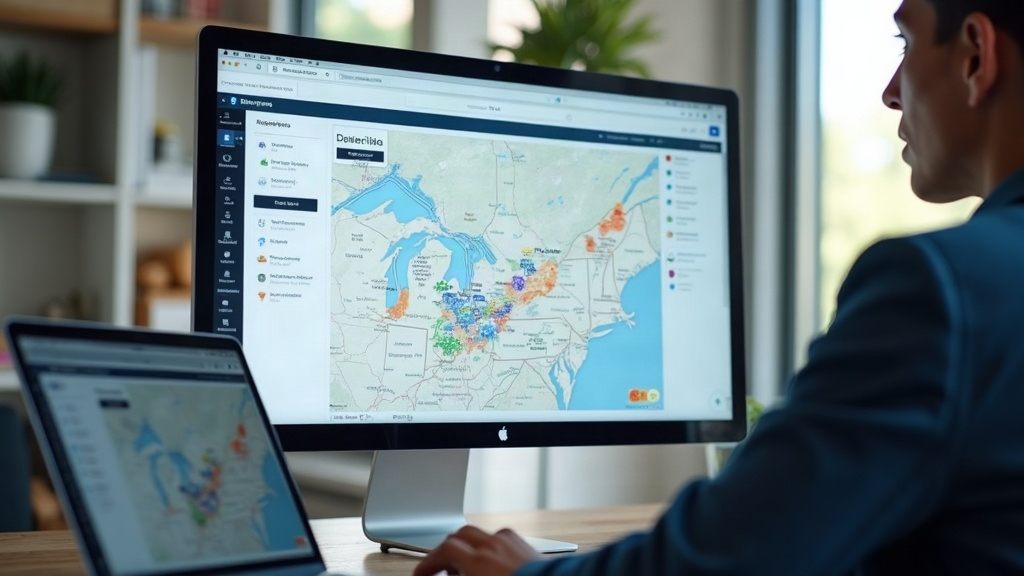
What is enterprise SEO? It’s the discipline of managing search visibility for organizations with large, complex websites — think hundreds or thousands of location pages, product listings, or service areas — where technical structure, internal linking, and crawl efficiency matter as much as content quality. For a brand with 300 NYC-area location pages, the biggest challenge usually isn’t writing content. It’s architecture: making sure Google can find, understand, and rank every single page without the whole structure collapsing under its own weight.
This is the problem internal linking solves. When it’s done right, a visitor (and a search engine) can move from a city-wide landing page down to a specific neighborhood page in two or three clicks, and link equity flows logically through the site instead of pooling at the top and starving everything below it.
What Is Enterprise SEO, Really?
Enterprise SEO refers to search optimization at scale — typically for businesses with 1,000+ pages, multiple departments touching the website, strict brand or legal review processes, and a technical stack that can’t be changed on a whim. It differs from standard SEO in scope, risk, and process rather than in basic principles.
A single-location business might have five or ten pages to optimize. An enterprise operation with a presence across dozens of NYC boroughs and neighborhoods might maintain hundreds of near-identical location pages, each needing unique value, internal links, and a reason to exist in Google’s index rather than being flagged as duplicate content.
- Scale: Hundreds or thousands of URLs instead of a handful
- Governance: Multiple stakeholders, legal/compliance review, brand guidelines
- Technical complexity: Large sitemaps, crawl budget constraints, templated page systems
- Cross-team coordination: Dev, content, local marketing, and paid media often need to move together
If you want a deeper breakdown of how this applies specifically to large organizations, our enterprise SEO services page covers the full scope of what’s typically involved.
Why Internal Linking Becomes a Core Problem at Scale
With ten pages, internal linking is almost an afterthought — you link where it makes sense and move on. With 300 NYC location pages, it becomes a structural engineering problem. Without a deliberate linking plan, three things tend to go wrong:
- Orphan pages: Location pages with no internal links pointing to them rarely get crawled consistently and almost never rank
- Diluted authority: Homepage and category pages hoard all the link equity, leaving deep pages starved
- Duplicate-content confusion: Google can’t tell which of several similar neighborhood pages deserves to rank for a given query
Enterprise SEO teams solve this with a layered linking architecture — a deliberate hierarchy that mirrors how a user (and a crawler) should logically move through the site.
How to Do Enterprise SEO: Building the Linking Hierarchy
Most enterprise location structures follow a pyramid model, moving from broad to specific:
- Tier 1 — Regional hub page: e.g., a “New York” or “Tri-State Area” landing page
- Tier 2 — Borough or city pages: Manhattan, Brooklyn, Queens, the Bronx, Staten Island
- Tier 3 — Neighborhood or ZIP-level pages: Williamsburg, Astoria, Park Slope, etc.
- Tier 4 — Individual location or service pages: the specific storefront, office, or service-area page
Each tier links downward to its children and upward to its parent. Tier 3 and 4 pages also cross-link laterally to nearby, related locations — a Brooklyn page might link to its closest neighboring boroughs, giving users (and crawlers) a natural path to explore adjacent service areas.
A Practical Example
Imagine a regional services brand with a hub page for New York, which links to borough pages, which link to neighborhood pages. A visitor landing on the Brooklyn page sees a module linking to Park Slope, Bushwick, and Bay Ridge. Each of those neighborhood pages links back up to Brooklyn and across to one or two nearby neighborhoods. No page is ever more than three clicks from the homepage.
Templates, Not One-Off Pages
At this scale, pages are built from a shared template with dynamic internal-linking modules — a “nearby locations” block, a breadcrumb trail, and a regional footer menu. This keeps linking consistent without requiring manual updates on every page every time a new location launches. It also means audits and fixes can be rolled out site-wide rather than page by page.
Running an Enterprise SEO Audit on a Location Network
Before building or fixing a linking structure, teams need to know exactly where things stand. Here’s how to do an enterprise SEO audit on a large location network:
- Crawl the entire site with a tool capable of handling thousands of URLs, flagging orphan pages and broken internal links
- Review crawl budget and server logs to see which pages Googlebot actually visits — and which it ignores
- Check for duplicate or thin content across similar location pages, a common issue when templates are copied with minimal customization
- Map the current link depth of every page — how many clicks from the homepage — and flag anything buried too deep
- Audit internal anchor text for variety and relevance, avoiding exact repetition across hundreds of pages
- Confirm indexation status in Search Console, comparing submitted URLs against pages actually indexed
This audit stage is also where businesses typically decide whether their current content management system can even support the structure they need — which leads to the software question.
What Is Enterprise SEO Software and Do You Need It?
Enterprise SEO software refers to platforms built to handle the scale and complexity that standard SEO tools weren’t designed for — crawling tens of thousands of pages, tracking rank data across hundreds of location-specific keywords, and integrating with large content management systems or custom-built platforms.
These platforms typically offer:
- Large-scale crawling and log-file analysis
- Rank tracking segmented by city, neighborhood, or service area
- Content duplication and cannibalization detection across similar pages
- Workflow and approval tools for teams with multiple stakeholders
- API access for integrating SEO data into business intelligence dashboards
Software alone doesn’t fix a linking architecture — it surfaces the problems. The strategy and execution still require experienced hands interpreting the data and making structural decisions, which is where working with a dedicated SEO services partner tends to save significant time.
How Much Does Enterprise SEO Cost?
Enterprise SEO costs vary significantly based on the number of pages, the complexity of the tech stack, and how much hands-on technical work is required versus ongoing content and link strategy. Rather than a flat monthly number, pricing tends to reflect a few key cost drivers:
| Cost Driver | Why It Affects Price |
|---|---|
| Number of location/product pages | More pages mean more audit, template, and linking work |
| Technical complexity | Custom platforms or legacy CMS systems often need more development hours |
| Content needs | Hundreds of unique location pages require real content work, not just templates |
| Reporting and stakeholder structure | Multiple departments or franchise owners often need tailored reporting |
| Ongoing vs. one-time work | Initial audits and rebuilds cost differently than ongoing maintenance |
Because the scope swings so widely between a 50-location brand and a 2,000-location one, enterprise SEO is almost always quoted after a scoping conversation rather than a fixed public rate. If you’re trying to get a realistic number for your own site, the most useful first step is a conversation about your current page count and goals.
Where Enterprise SEO Services Overlap With Local SEO
Large location networks sit at the intersection of enterprise SEO and local SEO. The overall site architecture is an enterprise problem, but each individual location page still needs to compete for local search intent — “near me” searches, Google Business Profile visibility, and neighborhood-specific keywords.
This is why enterprise SEO services and local SEO services often work together rather than as separate efforts. The site-wide linking structure gets pages crawled and indexed; local optimization — including Google Business Profile SEO for each physical location — gets them actually ranking in the map pack and local results once they’re found.
For brands whose location pages are built on WordPress or an ecommerce platform like Shopify, platform-specific considerations also come into play, from how category pages are templated to how store-locator functionality handles pagination and crawlability. Our WordPress SEO and Shopify SEO teams typically get involved at this technical layer.
Common Mistakes in Large-Scale Location Linking
- Linking only downward, never laterally — neighborhood pages that never reference nearby neighborhoods miss easy relevance signals
- Using identical anchor text everywhere — “click here” or the exact same phrase hundreds of times looks manipulative to search engines
- Letting the footer do all the work — a giant footer link dump isn’t the same as a thoughtful contextual linking strategy
- Forgetting pagination and crawl depth — if borough pages are listed 50-per-page with no clear path to page two or three, deeper pages get buried
- Treating every location page as identical — Google increasingly rewards genuine local detail over copy-pasted templates with a city name swapped in
For organizations managing this across multiple regions or even multiple states, the logic scales the same way — a states-we-serve structure works on the same tiered principle as a city-to-neighborhood hierarchy.
Bringing It Together
Building internal linking architecture across hundreds of location pages isn’t a one-time project — it’s an ongoing discipline that touches technical SEO, content strategy, and local search all at once. Done well, it turns a sprawling website into something both users and search engines can navigate with confidence, page by page, borough by borough.
If your organization is sitting on a large location network in New York and isn’t sure whether the current site structure is helping or quietly holding pages back, it’s worth a conversation before guessing at fixes. You can see more of our approach and client work in our case studies, browse more guidance on our blog, or find us directly on Google when you’re ready to talk through what your site actually needs.
Tells Google to show you more from Robert Gerov Media in Search.
Related Posts
Does Google My Business help SEO? Learn how NYC businesses can use Google Business Profile attributes to rank higher and win local pack visibility.
Does Google My Business Help SEO? How NYC Businesses Can Use Attributes to Stand Out
What is AI SEO and how do NYC businesses win AI answer boxes? Learn how to structure FAQ schema correctly to get quoted by AI search tools.
What Is AI SEO? How NYC Businesses Should Structure FAQ Schema
What is enterprise SEO and how does it apply to large NYC location networks? Learn how teams build internal linking architecture across hundreds of pages.
What Is Enterprise SEO? Internal Linking for NYC Location Pages
What is national SEO and why do regional markets lag despite strong NYC rankings? Learn the 7-step audit process to find and fix the gap.
What Is National SEO? Auditing Weak Regional Rankings Beyond NYC
What is local SEO when you have no storefront? Learn how NYC service-area businesses can rank for nearby searches with the right strategy and setup.
What Is Local SEO? A Guide for NYC Businesses Without a Storefront
What is an answering service and how can it help NYC restaurants stop losing reservations during peak hours? Here’s how it works, costs, and what to ask.
What Is an Answering Service? A Guide for NYC Restaurants Managing Peak-Hour Calls
Not sure if you need fractional cmo professional services or a consultant? Compare scope, cost, and accountability to find the right fit for your NYC business.
Fractional CMO vs Marketing Consultant: What Your NYC Business Needs
What is white label marketing and how should NYC agencies handle client escalations under it? A practical guide to protocols, communication, and partner vetting.
What Is White Label Marketing? Handling NYC Client Escalations Right
What is programmatic advertising and how should NYC advertisers set viewability benchmarks for display buys? Practical standards and tips inside.
What Is Programmatic Advertising? NYC Viewability Benchmarks Explained
A bing advertising agency perspective on structuring Bing Shopping campaigns for NYC seasonal retail, from feed audits to bid strategy and timing.